Wednesday, January 21, 2015

Published in Plumwood Mountain Journal http://plumwoodmountain.com/helen-hagemann-reviews-final-theory-by-bonny-cassidy/

Bonny Cassidy, Final Theory. Artarmon, New South Wales: Giramondo, 2014. ISBN 978-1-922146-61-8


Helen Hagemann

Theories have been around for centuries. It was first thought that the world was flat, until Galileo proved the Copernican theory that the earth did actually revolve around the sun. Recently I purchased nail polish called Color Theory, and per se, was offered Bonny Cassidy’s latest collection titled Final Theory. In this work of free verse two main stories are evoked, but more importantly the poetry centres on the theory of “finalities”. Theory. There are several meanings to the word: abstract reasoning, speculation, an assumption based on limited information, a belief or principle that guides action or assists comprehension or judgement, even the branch of a science or art consisting of its explanatory statements, accepted principles, and methods of analysis, as opposed to practice. Head spinning!

Well, this is how I felt after reading Final Theory.

The collection is divided into four parts and appears as four distinct narratives, each separate page without a title. Before outlining the content of this poetry, it is important to understand that the disastrous worlds that Cassidy captures in these episodes are written from an interrogative stance. It is certainly not lyric poetry, but more post-avant. As Adam Fieled (2006) writes “post-avant poetry is distinguished from other forms of ‘po-mo’ by its deliberate shying away from the directly ‘personal’, as well as its engagement with ‘morally motivated abstraction’”.

Did I write abstraction? Yes. Most of this collection is fairly abstract. However, it is for a reason. The post-avant poet’s main aim is to avoid the lyric “I” and as Fieled (2006) writes, “the poet employs ‘Negative Capability’ to express contradictions and oppositions, harmonies and discords, without affixing his or her identity to any fixed locale”. We do know however, after several readings of each section, that Cassidy’s finalities (harmonies and discords) exist somewhere in the Pacific Ocean, in New Zealand, Tasmania, Antarctica, and possibly the ancient Gondwana. (This information is gleaned from Cassidy receiving a Marten Bequest Travelling Scholarship and her trips to these areas).

It is tempting to delve deeper into this collection in order to understand the literal level of the poetry. However, in the light of the above that we are dealing with post-avant poetry, this is not possible. Instead, I am tackling this review by looking at each of the four sections in terms of binaries.

They are: birth / death – aesthetic / catastrophic – factual / mythical, with varying rhizomes.

In the foreword, these images set the tone for what is to come:

    A camera tracks the ocean floor

    (eating images, not colliding). And rests. …


    A child plunges headlong into that valley

    scuttling crud.


    The camera is her dream tunnel. …

    (1)

On the previous page, there is a quote from Lionel Fogarty’s “Scenic Wonders – We Nulla Fellas”: “Ranges and countless channels uninhabited’ /… ‘cones / knives, volcanoes borning a surface external / wave, rock over arid plains are not far from our base.” From Brian Cox and Andrew Cohen’s, How The Universe Will End, this quote appears: “Nothing happens, and it keeps not happening forever… on the long road from order to disorder.” Now we have some inkling of where this is going!

In Section 1, expect to be transported to the aftermath of New Zealand’s earthquake in the south island, possibly Christchurch and its surrounds.

    Bucking

    under

    distant melt


    […]


    an envelope of land

    is opened and warm-skinned

    cold-blooded ocean welling.

    (14)

What is at stake here is the morality / immorality binary of this catastrophe. The land has been corrupted, as Cassidy writes, “see the little bastard coming to the fray. / An inkling child of oil and grit” (14). Yet, the “day glows” and on Steven’s Island the scene is inviolate:

                                 … wren, piopio, huia, saddleback, kokako,

    short-tailed bat, long-tailed bat –

    who opened a gap and thudded through, back-first.

    The place became

    a host of wings, a fall of parrots. …

    (16)

Section II diverts from the disaster caused by nature and the ultimate survival of the natural world. In some way we are carried forward (or is it back to Gondwana?) to where in “some future ocean our beloved proteins will / roll, perhaps finding one another, linked / by a theoretical wave” (18). At a guess, the binary in this section is either “obliteration / creation”, “or birth / death.” A child is involved and the poetry is mythical, strange, she comes:

      face to face with a rubber alligator


    then wheels, seeing

    the alligator dissolve as she grows:


    byproduct, polymer-spun

    and grasping.

    (21)

The setting of the ocean with its water flowers and flushing weed is metaphorical. Cassidy appears to re-create the child’s life as a life saved and lived in water. It’s a slow letting go, but death is lengthened, perhaps not realised, until:

     … they’ve clustered on a corpse she snatches

    at the crowd, fills her mouth, cancelling their fuss

    with her fried tongue.


           But in the landscape of her head

          one lives on …

    (28)

Section III introduces another landscape that hints of isolation but, more to the point, of being slightly inhabited / uninhabitable: “try to make its faces out: they’re deserted” (39).

    Swerving from the valley’s head

    pipes cascade silently

    and divert

    to a compound buried in slick white rock.

    (43)

The two people in the narrative, rather than being “in the detritus of the old harbours” (6), are on “high ground” staring across a valley and in “one of the cars some kids / amped their dying stereo / so it shone across the valley” (39–40).

    A biplane lifted from its beach and wiped up light.

               […]

              The lake rose, floating

              on the valley

              then deepened to a stop.

              Sailing peaks.

    (40)

In Section IV, we return to the child / girl, although the “she” point-of-view of water-baby or survivor is unclear. However, certain aspects of the binary of factual / mythical are evident in this final poetry. The setting of caves, the ocean, the rift of ice, and “on the surface: canisters, their reels of punctured weed” (67), “the plastics she has loved” (66), appear as evidence to the aftermath of a previous disaster or catastrophe. The “she” person in the poetry also has an affinity with and appears to be floating in this fallible landscape.

    Rummaging the hadal scum

    she rips white clams from their roots

    and sifts with toothless gums.

    (69)

We could hardly believe that this character / child or super woman would be human, surviving hours below the sea, being flung high to a cliff face, and then have her “bellows grind through avenues of the last ice” (70). One supposes she is likened to a mythical character, similar to the Greek sea-goddess Thetis who had the power to change her shape at will.

    Nose to sloppy ice

    she gnaws –

    a line draws itself


    across her head

    and silently folds

    inward:


    the thin zones inch


    she rises

    involuntary

    (70–71)

Apart from the obscure nature of this radical poetry, it must be mentioned that the work has a foray of excellent poetic techniques: strong rhythm, imbibed tone, powerful imagery, a picturesque view of the natural world, a motif of photography (as real / made-up images) and unforgettable phrases such as: “to understand why the ocean ends / here. Drinking from the teeth / of the cliff” (25) and “down the rift / (past a rusted box, its long eye gazing into sludge)” (67). Final Theory might not be for all, especially lovers of lyric poetry, but for those who like L=A=N=G=U=A=G=E, post-modernist, experimental or post-avant poetry, it’s a challenging read.


Reference

Fieled, A (2006) “Rachel Blau DuPlessis and Abstract Morality in Post-Avant Poetry”. Cordite Poetry Review (30 June). http://cordite.org.au/features/adam-fieled-rachel-blau-duplessis-and-abstract-morality-in-post-avant-poetry/


Helen Hagemann is a Perth poet. She has two collections of poetry, Evangelyne & other poems (APC, 2009) and of Arc & Shadow (Sunline Press, 2013). Currently, Helen is working on a children’s collection titled Miniscule.

Sunday, December 28, 2014

Season's Greetings to all my viewers, no matter where you are, may you have peace, joy & love in your life and a happy & safe New Year - more poetry to come in 2015!
Many thanks to google for putting this video together, geez I don't think I could have done it without them :) - sure was a great effort to find the embedded html code though.

Saturday, December 20, 2014


Wednesday, November 12, 2014

Writers on Bimblebox Birds

Figbird

Bimblebox Nature Refuge is under threat from massive coal mining projects (including Clive Palmer) both directly over and under the refuge plus all around it, throughout the Galilee Basin. This means that the myriad life that thrives on Bimblebox is under threat, including the birds.

Bimblebox recorded poem:  Brown Honeyeater: Lichmera indistincta
Listen to Helen Hagemann read her poem Brown Honeyeater.  Play Sound


Brown Honeyeater: Lichmera indistincta


A brilliant blue, rising from a bronze morning
& Brown Honeyeaters are circling the garden.

Today, they are in the olive tree in my neighbour's
yard, performing aerial songs (although it's more a short

sharp, tweep!). Before spring, I counted two regular
visitors to our horticulture of Canna lilies, Yellow

Bird-of-Paradise, Grevillea, Frangipani, now there are
four! As if in concert, they dance, plunging to & fro.

It's balletic, reminding you of Rudolf Nureyev & Dame
Margot Fonteine in Romeo & Juliet. One of the

fledglings is as graceful as Maria Kochetkova, a
Giselle fluttering her wings, thin as the veil of a tutu.

There's fussing from parents, followed by a preen on
brick wall and hedge, a bird commotion of tutelage.

The best is their closeness, high in the branches, and now
that the young are fed and sleepy, the show has stopped.

Thursday, November 6, 2014


The Fascinator

I am at the Rec centre
listening to Eye of the Tiger,
the woofers and tweaks
from a broadcasting screen
of the Melbourne Cup.

I am also wearing a flowered hat
fashioned from a dewy morning. Three roses
& the absurdity of a polka dot crown
that becomes a curious millinery piece.

We are twenty five women talking above
the call of the race. Mostly, we know
nothing about horses, but do know songs
like Soda Pop, Williams' & Bublé's
jazzy tune we exercise to.

I could not predict the fortune carved into today.
I did not read the signs of Scorpio or Mercury
finished with its retrograde. How could
I know I would win a Melbourne Cup sweep,
have a great birthday surprise or win the award
for my Fascinator. Homemade. I could not.


Sunday, October 26, 2014

It's always nice to have a break from your usual weekly routine, spending a day at the Applecross Senior High School. It was a great alternative and exceptional time. I spent two separate hours with Year 11 students (also separate classes) and we worked on some poetry, mainly looking at metaphor. The task was to write about their family, eg. mother, father, and possibly two siblings. I used a workshop written by Canadian poet Patrick Lane who has his own wonderful images. However, one young boy wrote a very funny line;- "my brother is a rash, and is always irritating."

Class teacher is Veronica Lake, who painstakingly every year publishes a book of poetry with prize winners from all submitted high schools. This year the first prize winner blitzed the prize with a great poem titled, Wholly in the Deep.

Copies of this anthology can be bought from me by telephoning 0404666156, or through the Applecross Senior High School, Western Australia.

http://www.applecross.wa.edu.au/

Friday, October 17, 2014


Travel Mementos
               for Lucas North (1973-2013)

Wherever we went,
I brought one home,
a mug, teaspoon or book filled
with the memories of our travels.

Of all the fridge magnets
on the door, you said.
There's too many. What do you
want them for?

To recount where we’ve been, I said
what we did and saw.
I pointed to the Del Rio pelican
in the Hawkesbury scene.

Remember the kangaroos crowding
the golf course at dusk?
From the top of a kitchen shelf
I lifted a candle, dark as a pint of ale.

And look! These four magnets
mapped our circling through the mountains,
from Ocean Beach to Patonga, 
from Saratoga to Umina.

And here‘s the riverboat at Spencer,
our last stop before a treacherous climb,
those boggy edges slipping us
to my brother's Hunter Valley farm.

Left on your desk now, a curled notebook;
sodden rain caught us camping in November.

The bright glow of your frame survives, the
day you slipped an arm around the bronzed
Solomon Wiseman. A cap angled on his rigid
head, bringing the green back into your eyes.


Sunday, October 5, 2014

Friday, September 12, 2014


Christ Konrad and Helen Hagemann - Reading at the Moon Cafe - 13th September
Here's our Profile
http://www.perthpoetryclub.com/saturday-13th-september-christopher-konrad-and-helen-hagemann


Reading poetry this Saturday, 13th September at the Moon Cafe. It's always great to share a spot with another fine poet and that is Chris Konrad. Starts at 2pm til 4pm. Food and wine are also available in the front section of the cafe. Often the club is filled to capacity. And it's thanks to the many hands who dedicate their free time, that makes this event successful.
http://themoon.com.au/events/perth-poetry-club/


Friday, August 29, 2014


Poetry Workshop with Tony Curtis

He tells jokes and Irish tales, takes you into
a Dublin pub with barrels of whiskey, his words
phrasing like the soft swish of a poured pint.

When the room writes to the tasks of the day,
he slips you into the backlog of home, through
old grumbling nights with the porch light on.

His guitar is the sound of dusk under the
lemon tree, or laneway where you smoked
cigarettes made from Gum tips. He sets your

mood, as distinct as the sun is to the stars,
even the planets are aligning themselves
with your laughter, throbbing into the room.

He's better than that Tony Curtis in Some Like 
it Hot. Hilarity like a gunshot waking you up,
as if poetry writing could lift you from your

heavy bootstraps in winter, take you to the park
like a kid on the roundabout, a bag full of chocolate
drops going round and around. Then like a breeze,

he lets loose without discretion, letting sticky,
gooey wrappers fall to the ground, so that your
swallows of marshmallow and cocoa feel like

sex, chewy nougat like intercourse, strawberries
rolling about like tongue seduction. In the end, he 
has you where he wants you  - writing poetry.

Monday, August 25, 2014

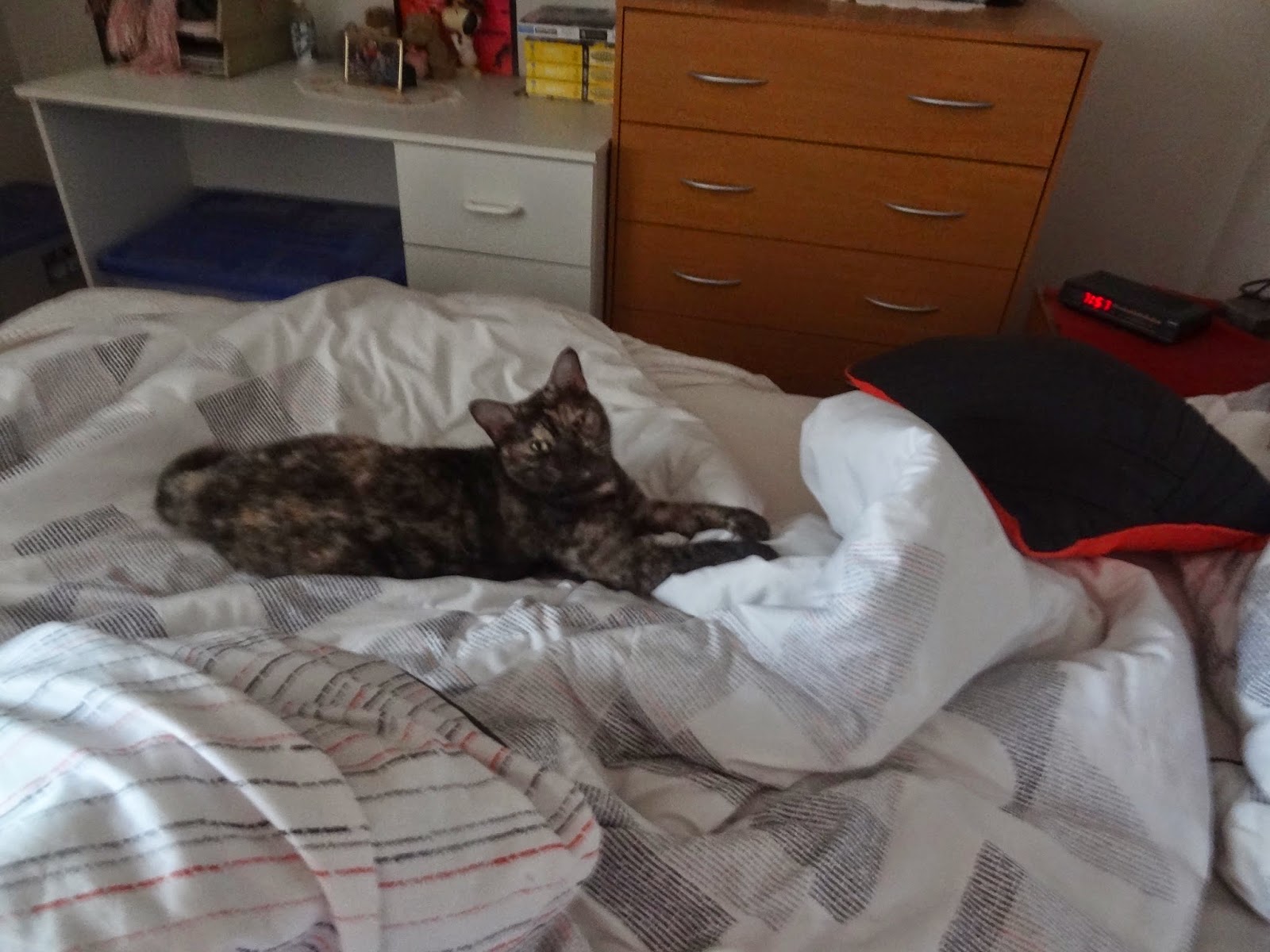
Creature Comforts

There are several rooms in the house,
with pet beds in geometric shapes.
Some have man-made fibres, others wool.
One has a compartment the animal
can travel through. With no expense spared,
it's a courting to give the cat ample space,
a silence where no dog lives.

At midnight, there is a weight of four paws
awakening your impoverished dreams,
the cat, finding a waist in the shape of a sweater,
or liking your scizzored legs, curls there as if you
might not notice a lump of floating fur.

In three degrees, she finds relief
near your face or in the abundance
of PJ's no longer one thing, yet another.

She'll be content at 2.00am
to snore inside your ear, or play
hopscotch as you turn, stretch pelvic floor to feet.
Fearful, watchful, fitful, she'll nuzzle
wildly into your craving sleep,
doona meeting two minds like opposing planets,
sheets cooling at both tail ends.

You're not prepared for this torment
as you plunge through it.
Nor can you turn the clock back
to what came before,
not this lifetime of coming together.
It would be like metal without a shape,
no sound without a bell,
a bell without a clapper.


Wednesday, August 20, 2014


Young Love 


Under the outside porch, the wind knocks at the windowpanes. You crouch down on the front step, it's comical and the little petals of his pink corsage brown with exhaustion. Your hand shakes, pinning it onto your cardigan, and quickly you rush through the streets to the entertainment hall. Red lights charm musicians' faces. This beautiful kingdom is in the mood, and now it's 'Rock around Clock'. You put your high tail on, flay back, pucker lips, spin in the wave of his arms that dominate the night, tap the parquet floor as if it's the clickety-clack of the train that runs beside the sea. Your shining face is a rose in his eyes. The dance is a handshake like a weapon that pulls you quickly from fear, then back again into the light. Your right leg swings a charleston side to side. It's a kick high, kick back. What a dance! What a dancer! See how his hands are like handlebars, as he jitterbugs to the right of your body in opposite flight, a two-time double shuffle according to his beat. You follow. He spins, pulls you in, pulls you back, and under as if you're going through town in his white Cadillac, absorbing his grace, his dimpled chin, as he hauls you into a night full of stars, and then the vibrations of the hall subside, and you're back on the porch, with the lights left on. You don't see his hands holding your face, kissing your face with makeup in your eyes, and he goes away, crushing the heavy bushes you've both stepped from, your bobby socks full of burrs. You walk inside, into the rest of the night, tap on the wardrobe, tap on the bed, tap on the headboard overhead, your heart in paradise.

Friday, August 1, 2014

As a woman, I would add the following list:-

1. Do nails
2. Attend exercise class
3. If raining, attend the new Danny Green Gym
4. Have coffee with the girls
5. Shop for food, clothes, make-up, etc.
6. Talk to daughter on the phone for 2 hours
7. Do some gardening, preferably trim bushes, pull weeds, cut winter roses
8. Prepare a creative writing class/ notes/ research
9. Take the dog (or cats in my case) for a walk to the park
10. Babysit the grandchildren


Bounty

Bounty
Prose Poetry

The Five Lives of Ms Bennett

The Five Lives of Ms Bennett
A Family Saga

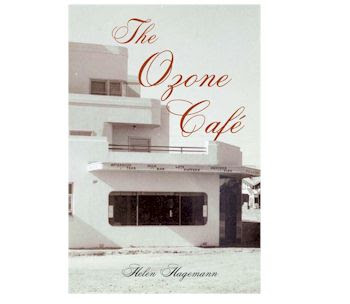
The Ozone Cafe

The Ozone Cafe
White Collar Crime

The Last Asbestos Town

The Last Asbestos Town
Available from Amazon

Evangelyne

Evangelyne
Published by Australian Poetry Centre, Melbourne

of Arc & Shadow

of Arc & Shadow
Published by Sunline Press, WA

Blog Archive

Powered by Blogger.

Search This Blog

Flickr Images

MBA (Wrtg) ECowan

My Photo
Perth, Western Australia, Australia
Helen Hagemann holds an MA in Writing from Edith Cowan University, has three poetry books: Evangelyne & Other Poems published by Australian Poetry, Melbourne (2009) and of Arc & Shadow published by Sunline Press, Perth (2013). Bounty: prose poetry is published by Oz.one Publishing in 2024. She has three novels published The Last Asbestos Town (2020), The Ozone Café (2021) and The Five Lives of Ms Bennett a result of her Masters degree at ECU (2006), is published by Oz.one Publishing (2023).

Helen Hagemann MBA (Wrtg): ECowan

Helen Hagemann MBA (Wrtg): ECowan
Author & Poet

INSTAGRAM

Popular Posts