Wednesday, May 29, 2013


Tuesday, May 28, 2013

This is How you Lose Her
Review by Helen Hagemann

I must preface this review with the origins of discovering Junot Diaz. His works were highly regarded and recommended by visiting writer, editor (Granta) and literary critic, John Freeman. It was February 2013 at the Perth Writers Festival where Freeman offered a slew of good authors to read. Many I hadn't heard of before. So, in this global, ever-shrinking world that expands literary knowledge, here it is, all but brief.

In Junot Díaz's collection This is How You Lose Her each story follows Yunior, a Dominican immigrant, through relationships from his teens to mid-life. Each story is interconnected, so that there’s a broader picture of Yunior’s male prowess and his attitudes toward and failures with women. There are so many stories that are raw and ungracious, most are peppered with Spanglish (a reference index would have helped!) sexist language too, yet one can’t help thinking that the author’s main intent was to stay true to that bozo-type character. Women would have met this type of male before at any time, in any culture; pumped up and invincible. But as Diaz has stated: ‘there are two types of writers, those who write for other writers, and those who write for readers.” He prefers to keep his readers in mind when writing a story. They’re more likely to gloss over any mistakes and act as willing participants in a story, rather than actively looking to criticize his writing. So, it’s that Roland Barthes’ theory of “the author is dead”; we have to disconnect him from the character. A biographer once told me that one does not necessarily have to like a character, as long as they’re interesting. It's also interesting that Junot Díaz has opened up that fresh sea air to a window of another culture, with some of us learning a little Spanish along the way.
   
     Born in1968, Junot Díaz is a Dominican-American writer, creative writing professor at Massachusetts Institute of Technology (MIT), and fiction editor at Boston Review. He also serves on the board of advisers for Freedom University, a volunteer organization in Georgia that provides post-secondary instruction to un-documented immigrants. Central to Díaz's work is the immigrant experience. He received the Pulitzer Prize for Fiction for his novel The Brief Wondrous Life of Oscar Wao, in 2008. He is a 2012 MacArthur Fellow.

    His short fiction has appeared in The New Yorker magazine, which listed him as one of the 20 top writers for the 21st century. He has also been published in Story, The Paris Review, and in the anthologies The Best American Short Stories four times (1996, 1997, 1999, 2000), The PEN/O. Henry Prize Stories (2009), and African Voices. He is best known for his two major works: the short story collection Drown (1996) and the novel The Brief Wondrous Life of Oscar Wao (2007). Both were published to critical acclaim. Diaz himself has described his writing style as "[...] a disobedient child of New Jersey and the Dominican Republic if that can be possibly imagined with way too much education."

    On writing and the arts, Diaz has stated, "Art is what matters most, and if you’re not contextualizing for a larger push for the arts, what does it matter? What’s really relevant, important, and exigent is that all of us are under pressure to spend less time with art, and we’ve got to figure out a way to talk and encourage each other to do the opposite."

Monday, May 27, 2013


Saturday, May 4, 2013


Mother

A mother is yellow,
a sundial.

She is the window
where the soup
is cooking.

In darkness, she calls
from the landing
to bring sleepy eyes
up stairs for storytime.
A kiss with no explanation.

Mother is flour & ginger,
butter & creamy beaters,
knitting in the basket,
pulling you round
to put your cardigan on.

Mother waits in silence
no matter how late the clock.

She is an old love, as
soft as autumn rain
that slips through your fingers.


Mother

Mother is sugar
the heavy jars
of marmalade
who wants to put
back in the cupboard
all the years
it has taken
to be a body
ready
to travel.


Rag-time for Mother

One too many stories,
one too many truths.
You didn't steal the school bell
You didn't steal the glue.
The ants took all the breakfast,
the raisins are what’s left.
The cat's drowning was
your brother's wicked bet.
A friend your brought at Christmas
now wears your satin dress.
No, it isn’t what you wanted.
It isn’t what you'd choose.
She owes you fifty dollars
and hasn't paid her dues.
This poem is a present,
besides red socks & shoes.
What almost happened, won’t now.
Let's sing away the blues.


Sunday, April 21, 2013


Conversation Hearts

 You buy thirty candy hearts
         with visible signs of
                  you rock, be mine, call me.
  With each small disc buoyed
          in the hand, you catapult them
                  to the mouth, a tooth blast
   over sweet nothings of love. It’s
         Saturday, fifty years ago on the
                  shores of the eastern coast.
   Love is confectionery, sweet musings
          taking place on the bus,
                   in the shake of a bag.
   Not even the atmosphere of ten miles
          to a movie disturbs the party
                   in your mouth.
   You crack hug me into chalky bits,
          suck lucky lips over cloud nine,
                  chew cutie pie into spikes.
    Each heart seems a milestone in your life,
           honey breaks from moon,
                  wedding from cake.
    All you can do is roll the tongue over
           its sweet nature, remembering
                  a fractured night far off.
    Someone singing in the branches, dream
           boy on the grass, the sugary kiss
                 of real love on the mouth.


Friday, April 12, 2013

In Love with his Words

                           after Kenneth Koch’s ‘In Love with You’

Every woman loves the poet who rises
on a sunny morning, claiming his love.
So it’s a pleasure reading his words when he’s
in love with love, shouting O midnight! O midnight!

Seeing him pacing the carpet, the sun raining through
the window, you can’t help repeating phrases like
“love is a taxi” a world you enter into. He’s dressed in
a stiff white shirt. She is as beautiful as October.

Their heads are together, translating Russian. Their
eyes are bigger than love discussing the previous
night, glued to a pillow on the bed, their bodies
“a couple of ruins” like Carthage and Pompeii.

When you read stanza two, you want to walk into the
park with them, swinging arm over arm, stopping like
he does with her, feeling the penetration of eyes like
daggers, hot as the ball of sun, light as the spidery

shadows that creep across the bench. You think
of the red-tipped flame of their shared cigarette.
By the time you reach the third, the second stanza
folds into the morning like Corellas into their wings.

So it is better to leave the house, thinking of love's
dominion over her, over him, it’s physical effect.
The clouds must have been massive on that day,
love as calm as pigeons, words moving towards

the famous, the ungracious King Edward, and his
abdication. You could have cured his headache with
the power of words. The world was new, mutated,
you said. You could have given him the pill, the grey

hooded light of dawn, the electricity that night puts on
into its bright self, baskets of sweet scents, soft towels
gently lowered on the bathroom floor. Oh, and how you
were revivified, breezed with kisses, so unabdicated—.

Wednesday, March 27, 2013


Is this love?

the wind loose

and roses
on a path

filled with perfume

it stops me
along the lake

where we walk
in Dylan's moonlight

the night and your body
in it

the heady scratch of shadows
saturate

a lone cottage

wheels of lemon 
bob 

in our gin

and
on our tongues

Sunday, March 24, 2013


 Monday Poetry with Helen Hagemann continues at the Grove on Monday 25th March. This workshop “Writing Love Poems” will help poets towards the upcoming anthology, Australian Love Poems 2013 by Inkerman & Blunt. Poets cited: Charles Olson, Pablo Neruda, John Tranter, Chris Mansell, Eric Beach, Dorothy Porter, and more. 1.00pm start. Coffee and chat in the Grove's Coffee Shop after class. All welcome!
Venue: The Grove Library, 1 Leake Street, Cottesloe. (Cnr Napolean St) & close to Cottesloe train station.
Date: Monday 25th March
Time: 1-3.00pm
Cost: OOTA $15.00, Non-OOTA $20.00

Australian Love Poems 2013
The Perfume of Flowers
               by Charles Olson


The perfume
of flowers! A haw

drops such odour
it stops me

in the wall
of its fall. Love

arrests

Lime-trees

saturate

the night. We walk
in it

On a path jonquils
fill

the air. Love
is a scent.
 

Saturday, March 16, 2013

New Collection Soon to be Published by Sunline Press!


Grandmother & Granddaughter Poem

When my grandmother was frail,
not knowing it was cancer,
we’d sit in bed, facing each other;
two pillows at cornered walls, a toddy beside.
Gran would lift the lid of a brown suitcase, 
where apart from a silver wink in her eye,
she’d show fifty-percent of her life.
Nutmeg, cinnamon & ginger bartered in Malay stalls
at Paddy’s Markets, their spicy air arriving.
Tucked in newspaper: textiles, tablecloths, napkins,
slippers wedged together, a finery of nylon hose.
We’d go deeper & deeper, down into the suitcase,
Gran’s fingers tinkling glass buttons, pins, cotton reels.
Unpacking a day’s shopping, she’d lift my lips to sparkle
them candy-apple pink, round my cheeks with a light
touch of rouge; us mouthing ‘O’s’ like clowns in glass.
Gran just had her pills, so she prided herself with a new perm,
how her body warmed under a flannel shirt of her making.
Like those clowns we’d laugh at Gran’s bedside teeth,
coming out like stars. And she bequeathed me
more of her life. I knew she was happy, passing me
spindles of Ric-rac, ribbon, guipure lace; our hands
aglitter in bells & reindeers woven into braid.
She eased paper patterns from covers, kept material
when a bride. Citron pillow slips from her marriage bed,
now smelling of naphthalene, frayed at the edges;
her pale fingers, lucent as ice, shaking on the perfect
blue satin stitch of forget-me-nots.


This poem will be in my new collection "of Arc & Shadow" (tentatively titled). I know my poem Granddaughter & Grandmother has been popular so hopefully you will enjoy this! My grandmother was an angel, she taught me to sew, crochet, knit and also rug making. Although those skills have now lapsed, I remember her with great joy, spending time with me on the back step of our weatherboard and tin house.


Bounty

Bounty
Prose Poetry

The Five Lives of Ms Bennett

The Five Lives of Ms Bennett
A Family Saga

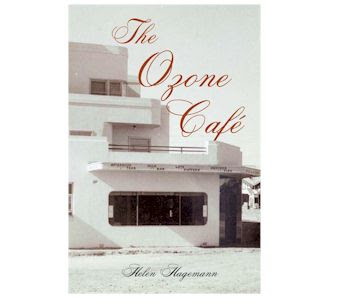
The Ozone Cafe

The Ozone Cafe
White Collar Crime

The Last Asbestos Town

The Last Asbestos Town
Available from Amazon

Evangelyne

Evangelyne
Published by Australian Poetry Centre, Melbourne

of Arc & Shadow

of Arc & Shadow
Published by Sunline Press, WA

Blog Archive

Powered by Blogger.

Search This Blog

Flickr Images

MBA (Wrtg) ECowan

My Photo
Perth, Western Australia, Australia
Helen Hagemann holds an MA in Writing from Edith Cowan University, has three poetry books: Evangelyne & Other Poems published by Australian Poetry, Melbourne (2009) and of Arc & Shadow published by Sunline Press, Perth (2013). Bounty: prose poetry is published by Oz.one Publishing in 2024. She has three novels published The Last Asbestos Town (2020), The Ozone Café (2021) and The Five Lives of Ms Bennett a result of her Masters degree at ECU (2006), is published by Oz.one Publishing (2023).

Helen Hagemann MBA (Wrtg): ECowan

Helen Hagemann MBA (Wrtg): ECowan
Author & Poet

INSTAGRAM

Popular Posts