Tuesday, September 11, 2012


Lost Property

To be alone in the wide room                                                                     
In the house’s crooked elbow, turning point                                                
For extensions as the family grew                                                               
And grew – and grew – to be alone in the one room                                     
Nobody needed now, though it might be resumed                                       
Like land, for guests or blow-ins, at any moment,                                         
Without notice (and that was part of                                                           
The appeal, the very tenuous feel of the place), to play there                        
At five or six to be immersed though not safe among the things                    
That proceeded you, immediate and limitless,                                             
Everything already there, the way the world went on                                   
Before you were thought of, the flux, and your small-child                            
Leisure for introspection while others shinnied trees for the same                 
Sense of endless outlook, here,                                                                  
In this would-be attic brought down to earth, whose breath                         
Was frosty on Mother Shipton’s well, holding the tossed refuse                     
Of older siblings, stages shrugged off: limp tutus, ping as dropped               
Gum blossom, too big, though you stepped                                                
Into them and stood, as if in a fairy ring you might animate:                        
Satin and tapshoes, toe-shoes from a sister’s long gone bit-part                   
In Hans Christian Andersen, poems called Off the Shelf                               
That you avidly grabbed for your own, puzzled                                          
At faded marginal doodles in real ink:                                                        
Dark ocarina whose holes you could never master,                                     
Bakelite cracked, spookily fake-organic,                                                    
As if a new kind of reptile had laid it,                                                         
And a distant, shadowy instrument, lipped, where fingers should sit,            
With verdigris your father later chastised you for rubbing –                          
An oboe perhaps – resisting your grip, but venting                                     
A slow corruption in you as descant,                                                         
Its distant kin in this vast orchestral silence:
Strange octagon you toyed with that would never quite close or open,
Squeeze box, little lung resisting pressure, push and draw, your hands
Impeded from fully parting or meeting, stretching
In musical secretion, cat’s cradle ectoplasm,
Crimped membrane so vulnerable to puncture,
It made you wince, lantern-thin but giving sound
For illumination. At last: harmonica, cupped, bracketed but not
For all that an afterthought, heart of the whole unpeopled
Space, for the way it moulded to your own small wheeze
And gave it a different life, if a pleasure to the player only,
Pleasure to make your mouth water, metal, felt, and papery
Velvet, though your brother might shudder
At the old spit he imagined pooled there,
To your it was honeycomb,
Striving to isolate each note, then giving up,
As if you had many voices at once, speaking in chords,
And could make yourself heard.

- Tracy Ryan

Monday, September 10, 2012

I will be reading my poetry from my new collection "of Arc & Shadow" at the Perth Poetry Club on Saturday, 22nd September: 2-4pm. Venue: The Moon Cafe,  323 William Street, Northbridge. Poets are usually given a 10 minute time slot and I will also be appearing with Alan Hancock, a new voice in poetry.  My selection may even include, dah, dah! Purple Swamphens.  Check out their other guests for September through to November, 2012. http://www.perthpoetryclub.com/22-sep-helen-hagemann-alan-hancock-joanna-neave
All welcome!

Saturday, September 8, 2012


Purple Swamphens


some purple hides near the tail
they go on making it from blue
gradually you become aware
of their bill in red, turquoise chest
to tiny face, white undertail,
brown and orange feet

the only purple is a distant view
of perfumed jacaranda
when purple is floral and warm
it settles on the sky over slatted roofs
when you go down to the water’s edge
Swamphens run in pairs, black tails
flicking Morse code amongst the reeds

an exquisite creature, runs a four-way spread
of feet as a fretwork to its flighty footwork

when purple socks hang to dry
you go on seeing that swamp-bird fly
not wade to the bank on the other side
purple socks fly in the wind, and when snug
inside your shoes, that space between foot
and cuff can’t be seen
much like the purple
on a black and Purple Swamphen 

Photographs by Helen Hagemann (c)

Wednesday, September 5, 2012


Thursday, August 30, 2012


I visited Ireland for three weeks in September 2011, and walked along the same roads and laneways every morning while staying in county Monaghan, at a writers' centre. I photographed interesting landscapes and came across this derelict house. It was too overgrown to go inside, but I could see inside, nevertheless.


Old as Cows are


A house sits in a field
uncared for.
Grey calm of slate roof
and a chimney’s cold air, puffing.
Year after year this cottage,
married to weeds, dies in bracken
and an ivy graveyard. Death for life.
Trees holding onto their view,
blackberry vines curl with fruit, saplings
spire by sentinels of wired posts.
A door sits back like a mouth where
no food enters. Windows look out
from a darkness within. A magnolia tree
is the last, healthy touch of a family,
planting. The raw stillness of it. 
And they who farmed here, gone,
foisted with the fight of poverty. White-
washed bricks, old as cows are, strengthen
in the sun; a face that sings to no-one, or
for whoever comes.


Saturday, August 18, 2012


Horses on the Hillside

An old world is taking place
just hanging there beside brush & lake.
Two horses, a mare & colt, graze on the
hillside, plumb with the lowering of cows.
They seem content in the softwood swirls
of green, of wildwood terraces.
It speaks volumes for them.
Dark & light brown rumps twitch. Muzzle to air
assumes the guise that no-one is watching.
Leaves fall without weapons. Birds tap
on old growth-rings of trees. This county
goes on the same, wearing its wings of colour
without the noisy flight of airplanes.  
Two horses in a paddock, looking at each other,
flaked grass in the corners of their mouths.
Listen, you can hear them whispering. 
Do they sense gutter fire, farmhouses alight?
Are the fields shaking off distant rumblings,
where now they live in the hollows
of grave stones? You say, a stream of men
still might come, saddle up, bolt away,
back into a conspiring night
of murder & mayhem.

Tuesday, August 14, 2012


Review by Helen Hagemann


Arrhythmia – symptoms of unreliability

Arrhythmia is a book that contains twenty-six short stories by a West Australian writer, Richard Rossiter. It is also his first collection published by UWA Publishing. Rossiter is a retired academic, having taught literature and supervised postgraduate creative writing students. He has also judged numerous literary and writing awards (including the WA Premier’s Book Awards). He is a consultant editor for Papers and has been the fiction editor for literary journals Indigo & Westerly.
    There are many well-written stories in this collection, including various generational stories of two families (there’s a family-tree legend in the back of the book), with the main family headed by Samuel and wife Ellen. We are led into their farming life with sons Winston and Jack in the first story called The Brother. It's basically a story about the harsh farm life and headaches. 

    One of the better stories that evokes pathos is The Boy who Lost Time. This story begins with young Jeremy being given a watch by his grandfather, only to find that his father keeps hocking it to pay for his gambling debts. Prior to a visit by his grandfather and grandmother, and not having the watch (it's in its second cycle of use), Jeremy tries to win a watch at the Claremont Show, attending with his friends. After spending all his money, he eventually knocks a gold watch from a spinning glass machine, but it is not silver like his own, it’s too big for his wrist and he knows he cannot show this watch to his grandfather. When the grandparents arrive, Jeremy runs away to avoid the inquisition and a betrayal of his father’s illicit habits.
    

Writing is centuries old. It is a silent honing, a courageous externalization of the internal workings of memory, experience and our connection with the world at large. It is craft that needs daily practice and commitment. Standards, and certainly a moral compass are needed when we convey certain storylines and archetypes to our readers. They will soon become aware of any amorality or unreliability, for example, towards a female protagonist by those who have crafted a male literature. Female readers are also concerned with stories that have an ordinary voice and possibly from the same consciousness. Over time female readers have developed a gender, race/class conscious “ear”. In other words we can hear the disingenuous language if conveyed about our image, especially in language such as “small breasts, lively nipples… her eyes, dark and intense, conveyed whatever men wanted them to do”.
   Shall we say, then, the male writer who purports to understand the mind and body of a woman takes risks.  Roddy Doyle’s novel The Woman who Walked into Doors is an excellent example of the male writer taking those risks, especially writing from a female point of view. The story is so confronting and heart-wrenching - yet as a woman’s experience of abuse - it is “believable”. Doyle creates a seamless transition from a male consciousness to a female’s – a writer using his moral compass and training.
    In Rossiter’s The Trophy Girlfriend, the main protagonist Laura is problematic. This is conveyed in the ending which appears ludicrous. Laura having been previously touted as a strong and empowered woman, and decidedly collecting her own trophy by cutting off her lover’s two dog ears, leaves in tears after dining with her female companions.  The narrator states, 'she could not control the tears'. This is where the text is incongruous and certainly not a female rationale. As readers we may suspect that either a). The author could not think of a better ending, or b). It is the male narrator’s accretion of the weak, stereotypical female. The narrator, perversely follows Descartes’ mind and body law, provides no criteria by which its scope or reliability can be gauged. (We achieve a moment of consciousness when the narrator is unreliable). There is a rigorous descriptive and fundamentally flawed diversion going on. The male narrator operates from the male mind, psyche, experience, and the academy, and we are thrown off track, brainwashed
again by an androcentric point of view, like “Laura’s going off the rails, Laura’s not a virgin, possibly “frigid”, better still a “sexual siren”. If we are consoling or understand the writer’s possible shortcomings, we will remain like an audience in a silent movie house - complicit, bewitched, beguiled and ….1950s stuff. If we say to ourselves, well, it’s just a story, we will pass-over such phrases as “her body was a commodity” in the face of our own characteristically human traits as women who have been conditioned by this dominant patriarchal consciousness. We will evade the system of existence of a male rationale. We will be fooled by the etymology of the “narrative”, the known feminine “weak” ending. Laura is really not empowered (as we are led to believe), she is weak and leaves in tears. I find this scenario rather at odds with the creation of the character, especially being strong within the paradox of taking her own trophy.    
   In closing, I have rated this work 3 out of 5. The collection does have many worthwhile stories told in the third-person point of view, where the male characters are believable, and that do offer a reliable narrator. Yet the work is spoiled by the intrusion of the authorial voice that seeks to convey a certain weakness in women. Arrhythmia appears to live up to its name when it comes to a subset of pre-feminism (1950s) and gender issues, i.e. symptoms such as weakness, fluttering, dizziness, being light-headed or feeling that your heart is running away.
    Rossiter is a good writer but one hopes that he might stick to what he knows best, stories from his own experience/memory/male consciousness, without the subliminal academic theory.

Saturday, August 11, 2012

 
 Ladylike by Kate Lilley - reviewed by Helen Hagemann
 
Poetry is often a mixed-bag. On the one hand you have lyric poetry which stems from the Romantics to modernism, and on the other - post- modernism - a term mainly aligned by poets who philosophise that not all poets lead eccentric lives, do not embrace "form & feeling", nor are they interested in the personal pronoun "I", or the one true meaning of a text. Hence, post-modernism is meant to free up old restraints to create renewed meaning. Lyn Hejinian and J.H. Prynne (Jeremy) are two main exponents.

As a reviewer as well as a reader of poetry, I am interested in the experimental, the avant garde and a certain amount of l=a=n=g=u=a=g=e poetry. I especially like the American poets, John Ashbery for his topsy-turvy inventiveness and Brenda Hillman who breaks-up language. Kate Lilley's poetry, however, is what I have mentioned earlier - "a mixed bag". More to the point, her poetry in Ladylike appears to be all of the above, i.e. modernism, post-modernism, the lyric, with some wider references and obscurity thrown in.

Taking the first section The Double Session into consideration, and having studied Dorothy Hewett at university, I empathise with Lilley's deep binary of the mother/daughter experience. Lilley questions this association in the Forward's Fifty Minutes, "In the criss-cross of mother and daughter, student and teacher, poetry and criticism, what is mine and what is hers?" I would say many poems enmesh Hewett's story, many intersect as the mother/daughter experience. After all Dorothy Hewett was passionately ideological in her personal life as well as an intense feminist, esp. in her work (novels/poetry). My favourite novel being The Toucher.

Of course Lilley is heavily influenced by Dorothy's oeuvre, but I believe within these kinds of influences she is a poet expressing "ecriture feminine" i.e. the disruption of the phallogocentric nature of language. Lilley, however, and she has to, marks a different position of voice and style, compared to Hewett. The section title poem in "The Double Session" (as a division of two stanzas) appears to be about Lilley's parents - Dorothy and Merv Lilley, both writers. In the last few lines she states: "how it made you feel small and want to leave/ searching for the lift and then the bus-stop,/ the distant clack of typewriters in the night./ Once our work is done these tapes will be yours."

In the section Cleft, When Ladies Meet is an interesting poem that reveals the same angst for freedom and the poet's search for independence (away from Mama).

Goodbye Mama, you made me what I am
Impeccable, light-fingered little Marnie/Margaret/Peggy
You can keep the mink I stole for you
I'm young and if I go now I won't have to lose my mind

The poem, Coil, impeaches pathos no matter whose experience it is, and more so because there is a black & white photograph of the young Dorothy Hewett, the epitome of innocence?

A lilac sheath to cover you
your wardrobe of opening nights
reduced to a simple party dress
snipped curls in plain paper
your bed hacked to pieces for the skip

It is the final line that brings the emotional engagement for the reader as a universal childhood experience. However, we cannot read these two poems as the basis of the collection. The rest of the poetry in the first section highlights the narrator's search for distance and her own ‘desires’. It is in this section that conveys the complex words 'queer/lesbian'. Many of the poems in 'The Double Session' appear as a way in, getting to the heart of the matter.

In the two final sections of the book, Lilley goes far beyond my university studies and knowledge. Both sections 'Ladylike' & 'Round Vienna' have black/white pictures of women, and in the poetry I become lost. The re-reading of these poems over a long period of time may be necessary to interrogate the narrator's implications. Further reading may also help, and in this way understand how Lilley's mind works, the intertextuality, the philosophy, Freud's Dora and the 1673 Mary Carleton, along with other ideas contained in these poems. I find her sparse writing style interesting, insightful, and a poet to admire. But I just can’t engage emotionally with these sections. Lauralude is a poem from 'Ladylike'. You tell me?

Proceed haughty coquette
footling kewpie
gingham haze

Vellum umber rubbermaid
a fair sea of permanent waves
cornflower corrigenda


My review on "Ladylike" by Kate Lilley can also be read here @ http://helenhagemann.blogspot.com.au/p/reviews.html

Wednesday, June 27, 2012


After a long hiatus and many rejections, I can finally add my second publication for 2012 to my list. Warning to the Gambler will appear in Cordite Poetry Review - Jackpot issue #39. Here's a PREVIEW. Check out the PUBLICATION of my poem at Cordite Poetry Review Editor: Samuel Wagan Watson.


Warning to the Gambler

The way in is through thick double doors, between foyered palms, past
elderly stewards kneading hands. Fifty-dollar notes are exchanged for
happy-go-lucky seats, silver-dint-bar-tinkling machines. They lay down
their cards, sit hunched into their rib cage; sink into a consciousness of
play and battle.
In this warning to the gambler, one sees imprisonment and little daylight.
How many gamblers have been trapped in aisled rooms littered
with cigarette ash, zoo noises, furniture oozing years of spilled gin?
How many gamblers have watched two Kings scarper into a barrel turn?
How many have seen the chips scuttle before a fall, that fraction
before a missed fortune?

Wednesday, June 13, 2012


Catastrophe

We await the path of the storm
Thunder barks overhead like the dog
Next door. She’s up, wailing her grief
When no-one’s home
The evening groans on
Without lights, the kettle’s usurped for the gas’s
Slow metabolic rate
We don’t recognize the path of this cyclone
Never having one this far
Sporadic winds whip and the neighbour’s
Fence is no longer a division
The roads are physical coatings of debris
What turns up when the roof’s gone
How do I know such things?
Knowing is going back in time
To a transistor radio, a bite-size beginning
Shedding those hi-tech conventions
Rain enters like a stormtrooper and alarms
Flick on/ off, clocks tick, but time is soon forgotten
It’s enough to know that a hot cocoa by candlelight
Will herald a woeful sleep
Waiting for the green party lights to blaze
All electrics on

Sunday, May 20, 2012


Wednesday, May 9, 2012

Old Heroes at the Memorial Club

To compose a poem on old heroes at the Memorial Club, which has probably been written before, is much like looking at the faces of men in the cockpit of fighter-bombers crossing over a mountain range. Once when enemy planes flew overhead they dropped bread, not bombs. People scrambled to find pigeons wiping their beaks in the cracks of white stones. At the old Memorial club, the diggers wore rubber-soled shoes where once they trudged through engulfing forests of rain. High lace-ups on the Kokoda Trail. Jack boots amongst the goats on the Isle of Crete. Combats in the trenches of El Alamein.
My Uncle Charles once visited the now defunct Memorial Club on the Central Coast. It was nearly midnight before he turned one hundred-and-nine and only a few patrons were playing cards. Perched high on a stool at the bar, his only company was a busty blonde who kept referring to him in intimate terms. Earlier, he had moved amongst the lanes of machines, talking to some old diggers who were hesitant to respond, elbowing each other at the sound of his Kiwi accent. When he found a sympathetic ear in an old bloke called Herb, he proceeded to tell him about his days in the Great War, ducking sniper fire in the desert. The heavy backpacks he had to carry. And in a sideways hold to his head, he demonstrated loudly how a bullet whooshed past like a jet fighter plane. He had found the night amorous and immortal, getting to know Sid and Barney, two war veterans who had supped into their own heroics. With winnings from the poker machines, he shouted beers all around and handed out Churchill cigars, telling them, that he had recently read, War and Peace and Les Miserables. How they smirked and laughed, how they misused their newfound friendship by slapping him hard on the back to a suicidal fall on the floor. Lucky for uncle he didn’t suffer any further indignities. He was cushioned, so the family story goes, inside the soft breasts of the waitress blonde, who called a taxi with the wisdom of her lovey-dovey words.


Bounty

Bounty
Prose Poetry

The Five Lives of Ms Bennett

The Five Lives of Ms Bennett
A Family Saga

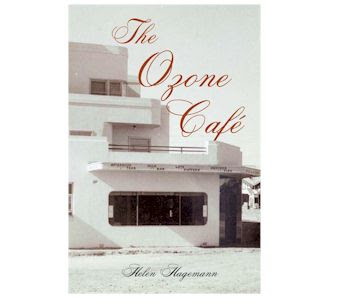
The Ozone Cafe

The Ozone Cafe
White Collar Crime

The Last Asbestos Town

The Last Asbestos Town
Available from Amazon

Evangelyne

Evangelyne
Published by Australian Poetry Centre, Melbourne

of Arc & Shadow

of Arc & Shadow
Published by Sunline Press, WA

Blog Archive

Powered by Blogger.

Search This Blog

Flickr Images

MBA (Wrtg) ECowan

My Photo
Perth, Western Australia, Australia
Helen Hagemann holds an MA in Writing from Edith Cowan University, has three poetry books: Evangelyne & Other Poems published by Australian Poetry, Melbourne (2009) and of Arc & Shadow published by Sunline Press, Perth (2013). Bounty: prose poetry is published by Oz.one Publishing in 2024. She has three novels published The Last Asbestos Town (2020), The Ozone Café (2021) and The Five Lives of Ms Bennett a result of her Masters degree at ECU (2006), is published by Oz.one Publishing (2023).

Helen Hagemann MBA (Wrtg): ECowan

Helen Hagemann MBA (Wrtg): ECowan
Author & Poet

INSTAGRAM

Popular Posts